
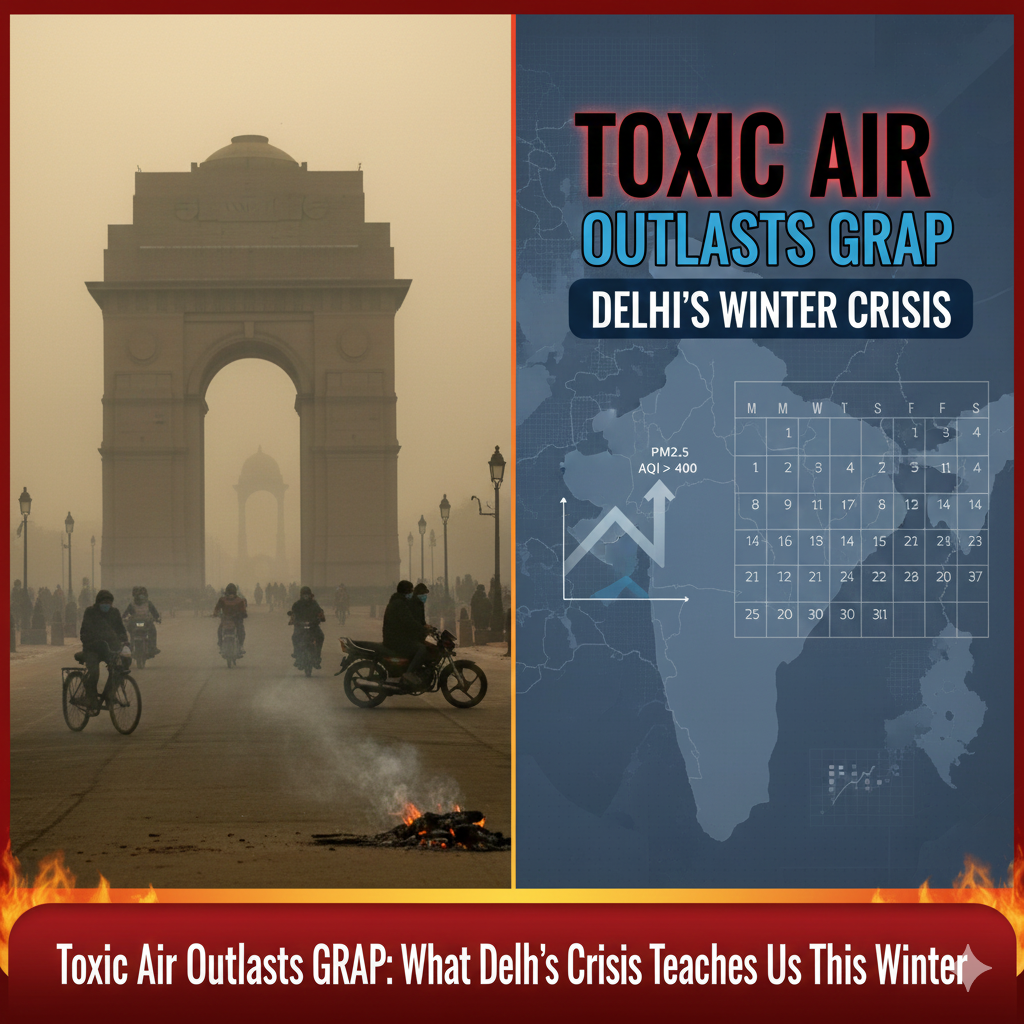
Air Quality Improves — But Pollution Persists
In late November 2025, the authorities overseeing air quality in Delhi-NCR revoked the Stage-3 curbs under GRAP after a brief drop in pollution levels.
Officially, the 24-hour average Air Quality Index (AQI) stood at 327 — marginally better than the “Severe” zone, yet still firmly in the “Very Poor” category.
Despite the change in rules — lifting bans on many activities such as non-essential construction and vehicular restrictions — the air quality stayed hazardous for residents of the capital.
This raises a blunt question: can short-term fixes like GRAP ever really fix a deeper pollution problem?
Read more : Hong Kong High-Rise Fire
What’s GRAP — and Why It Fell Short
GRAP is meant to be an emergency stop-gap. Depending on how bad the AQI gets, the plan activates different levels of restrictions:
-
Stage I: Basic dust and emissions control when AQI is “Poor–Moderate”.
-
Stage II (Very Poor): Restrictions on generators, stricter dust control.
-
Stage III (Severe): Complete halt on non-essential construction and demolition, ban on certain polluting vehicles, limits on outdoor activities, work-from-home for offices, hybrid school schedules.
Last week, when the city’s AQI began to improve — though not nearly enough — Stage III was revoked. But many experts argue that GRAP’s emergency-style, stop-and-start approach cannot substitute for long-term pollution control.
In effect, the authorities switched off the alarm — but the fire of pollution is far from under control.
Why Pollution Stays — Even After Restrictions Ease
🚗 Multiple Pollution Sources, Not Just Construction
Vehicles, industrial emissions, dust from roads, burning of crop residues in nearby states, and seasonal weather patterns combine to keep pollution levels high.
So even if construction dust or generator use is restricted, other sources continue to pollute the air.
🌫️ Winter & Weather Makes It Worse
During cold months, temperature inversion traps pollutants close to the ground. Delhi often experiences stagnant air, which prevents dispersion of harmful particles. This worsens pollution even if emissions are lower.
🔄 Episodic Restrictions Aren’t Enough
GRAP curbs are reactive — triggered only when AQI crosses a threshold. That means pollution builds quietly until it hits a “trigger point.” Once conditions improve slightly, actions are lifted — often too soon. That “on-off” pattern fails to sustain long-term air quality.
What Needs to Change — Beyond GRAP
✅ Continuous Pollution Control Policies
Cities like Delhi need ongoing measures — not just emergency fixes. This includes stricter vehicle emission norms, better public transport, curbs on crop-residue burning in surrounding states, regulation of industrial emissions, and control of dust from roads/construction sites.
✅ Strict Monitoring + Enforcement
Even after lifting Stage-3 curbs, authorities must regularly check vehicle emissions (PUCC), regulate industries, and enforce dust control. Sporadic checks are not enough — sustained vigilance is key.
✅ Public Awareness & Health-First Approach
People need to know the risks: poor air doesn’t just cause mild discomfort — long-term health hazards especially for children, elders, and respiratory patients. Communication, advisories, and awareness campaigns must remain active even when AQI improves.
✅ Green & Sustainable Urban Planning
Promoting green cover, better road planning, pedestrian-friendly zones, cycling lanes, and reduced reliance on private vehicles can reduce pollution at source over time.
